Investment Fraud Affinity Church
Scams using Religion Focused Faith-Based Ponzi Schemes
Duped by faith?
Scam artists often find the church and
its believers fertile ground for duplicitous dealings.
By SHARON TUBBS, Times Staff Writer - St. Petersburg Times - July
26, 2002
A scam always looks obvious from the outside. A wealthy Christian
died in New York who, out of the goodness of his heart, made provisions
in his will for believers all over the country to buy luxury cars
for a couple thousand dollars each. By the grace of God, you can
reap the blessings of this deal. Your car will arrive after the
property is released from probate, which will take about a year.
Make your cashier's checks payable to . . .
Yeah, right, you say. Suuuure.
But you're reading the story in the newspaper.
Now put yourself in a pew, looking toward the pulpit. The person
discussing the plan is the same person whose advice you trusted
to save your marriage, the one who encouraged you to live righteously,
the one who prayed with you in times of trouble, the preacher whom
you called "the man of God."
Federal authorities say hundreds of people across the country
fell for the fictitious story of a man named John Bowers who died
and left "miracle cars" for believers. The scam touched
home when at least 20 people at Breakthrough Christian Center in
St. Petersburg bought into it, too. More than a year ago, they
borrowed money from relatives, took out loans and dipped into their
savings for cars that don't exist.
These "miracle cars" netted more than $19-million from
New York to California from October 1998 to June when the U.S.
Attorney's Office arrested three people whom investigators say
were the masterminds and charged them with conspiracy, fraud and
money laundering.
As the story unfolded, people shook their heads and asked the
same question many of the victims asked: 'How could they be so
gullible?'
But authorities say scams targeting religious groups are unique.
They make victims believe their investments go beyond material
things. They manipulate the one thing they know they can find among
people who believe in a God they have never seen -- faith.
* * *
Last August, the North American Securities Administrators Association
arranged a news conference to warn people that religious investment
schemes were more widespread than ever, after losses from just
three national cases approached $1.5-billion.
One of them was the Tampa-based Greater Ministries International
Church scam, which operated from March 1993 to January 1999. Authorities
called it one of the largest pyramid schemes ever investigated.
Church elders promised to double investors' money in 17 months
under a "Double Your Blessing Gift Exchange" and a "Faith
Promises Program," thanks to gold mines and profitable overseas
investments the church claimed it had.
But the funds returned to some investors actually came from money
put up by investors at a later time. Last year, several church
leaders received lengthy prison sentences for their roles in the
pyramid scheme, which involved 18,000 victims who lost $448-million
during the 1990s.
Other scams to bamboozle believers are continually under way --
each proving that when you think you've heard it all, you haven't.
In April, the former pastor of a Pittsburgh-area church pleaded
no contest to 100 charges of defrauding the congregation, stealing
church property and violating state securities laws in a highly
publicized case featured on Dateline NBC. W. Michael Altman had
been hired as pastor of the congregation, now known as Grace Christian
Ministries, just a few months after his release from prison for
submitting a false statement on a loan application at a bank in
Birmingham, Ala., according to a story in the Pittsburgh Post-Gazette.
Altman convinced 43 people to participate in an investment plan
that caused them to lose about $355,500.
In March, Illinois law enforcement authorities arrested retired
police officer Bill Bresnahan, 54, whom they say falsely told churchgoers
he rescued bodies from World Trade Center rubble and prayed with
survivors on Sept. 11. Teary-eyed believers put about $3,200 in
the collection plate for the "hero."
* * *
Con artists gain the trust of their victims by professing that
they share similar spiritual beliefs. They gain credibility by
quoting Scripture and kneeling in prayer beside the very people
they hope to cheat.
"One of the most effective sales techniques is to use word
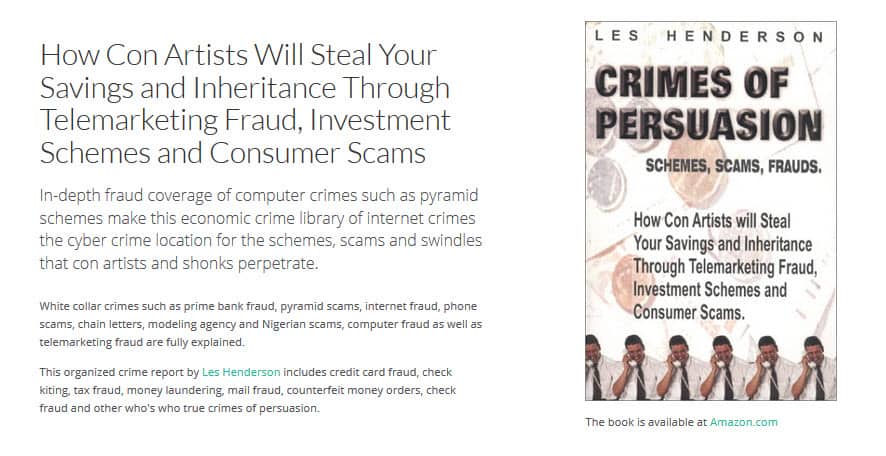
of mouth," said Les Henderson, who wrote Crimes of Persuasion:
Schemes, Scams, Frauds. "Scammers use this to their advantage
by infiltrating a known circle of those with shared interests.
Once they convince one key person, they use subtle peer pressure
to influence others who gladly relinquish decision-making to the
recommendations of those they know and trust."
At Breakthrough Christian Center in St. Petersburg, the miracle
cars scam played out like this:
Senior pastor Glenn Miller told his congregation last year that
the car deal would be an "uncommon harvest" of blessings
for their small storefront church. Members, some who had unreliable
transportation or none at all, were told they could buy all kinds
of cars on the cheap -- a 1998 Toyota Camry for $1,000, a Lexus
for $3,000, a Cadillac Escalade for $6,500.
Church members took his endorsement as a guarantee. To them, he
is a "prophet," a person who sees divine visions from
God. Some never saw pictures of their intended cars, didn't know
what color they would be, or whether they would be two-door or
four-door cars.
Miller also told members that the Rev. Creflo Dollar, the well-known
founder of Georgia-based World Changers Church International, with
more than 20,000 members, had also participated in the deal and
was expecting cars. That made Breakthrough members believe they
were in good company.
A spokesman for Dollar recently told the St. Petersburg Times
that not only had World Changers not participated in such a car
deal, but that no one had ever even approached Dollar or church
leaders with the idea.
* * *
Con artists gain the trust of their victims by professing that
they share similar spiritual beliefs. They gain credibility by
quoting Scripture and kneeling in prayer beside the very people
they hope to cheat.
In late June, Calvester Benjamin-Anderson, a member who had taken
out a $4,000 loan to buy a used Lexus and pickup truck wanted an
update. She called a number listed on paperwork that came along
with a receipt she got in the mail. Someone at the number referred
her to a toll-free line. She dialed. It was a recording at the
U.S. Attorney's Office in Missouri.
"There are no cars," the recording said. Four people
had been arrested on charges including conspiracy, fraud and money
laundering. Gwendolyn Baker, 51, of Memphis, James R. Nichols,
26, and Robert Gomez, 27, both of California were masterminds in
the massive scheme. Corinne Conway of Missouri was also arrested.
Baker's was the name some Breakthrough members were told to put
on their cashier's checks. According to federal authorities, Nichols
posed as executor of the Bowers estate and, along with the others,
collected millions since October 1998 for more than 7,000 vehicles
that investigators say never existed. Investigators say that some
of the victims' money was deposited into Nichols' player's account
at a California casino.
* * *
Ashley Baker, a spokesman for the North American Securities Administrators
Association, said there is a key to any religious scheme:
"They make faith in God synonymous with the investment scheme," Baker
said.
Once that happens, victims are loath to concede that they've been
taken. They believe giving up on their investment would indicate
a lack of faith in God, Baker said.
And even when they do realize it was a scheme, they try to handle
the matter among themselves, Baker said. "You're asking people
to not only admit that they were duped, but that their faith was
misplaced," he said.
After hearing from Benjamin-Anderson, Miller called a meeting
of car buyers at Breakthrough. About 20 people showed up, several
of whom had also bought cars for family members.
Some left the meeting believing that talk of a scam was an "attack
of the enemy" and that their cars were still coming.
"There's two sides to every story," one member told
a Times reporter.
The following Sunday, about 70 people gathered for worship. Miller,
a stout man with white hair and a white pinstriped suit, sang along
with his congregation.
Spent from the vigorous praise, he wiped the sweat from his brow
with a bright yellow hand towel that coordinated perfectly with
his yellow tie and handkerchief. Members had a joyous time last
Sunday during the evening healing service, he said before starting
his sermon. One woman came with legs two different lengths, he
said. But by God's healing power, she didn't leave that way.
"A leg that was shorter than the other grew out to normal
size!" Miller proclaimed, as amens and hallelujahs filled
the room.
He had a word from the Lord this morning. That word is "pray."
"Pray, and don't get impatient," he said. "Prayer
keeps the river flowing. Glory to the lamb of God!"
A miracle is about to take place at Breakthrough, he said. "You
ought to tell somebody, 'I'm on my way!' "
Worshipers turn to their neighbors: "I'm on my way!"
"The Lord spoke to my spirit man and said, 'I have put the
church, not only Breakthrough, but the body of Christ, through
a test,' " Miller told the congregation.
Some people have failed the test by gossiping, complaining and "crying
over a little piece of money," Miller said, apparently referring
to the members who spoke openly about losses in the car deal.
You just don't know, he said, God's got "millions in store
for you!"
The service took place inside a conference room at the Hilton
in downtown St. Petersburg. The week before, Breakthrough had left
its location inside a strip shopping center on 49th Street S in
light of eviction proceedings. According to court records, Miller
failed to pay landlord Ashok Shah nearly $32,000 in rent over three
years.
Shah said Miller consistently failed to pay the monthly $1,800,
not including taxes, he owed for three units since entering into
the lease in June 1999. In the beginning, Shah said, Miller would
tell him that members' checks had bounced and that the church would
make good on its debts.
Shah, who is a Christian, said he believed Miller, who also said
God would bless Shah "because I was blessing the church."
In a brief talk with a Times reporter, Miller said he knew little
about the car deal. He said he didn't know whether it was a scam
or not. Miller said, he also put money into the deal, but would
not say how much or what the money was used for. He said he had
heard from other sources that Dollar participated and relayed that
information to his congregation. Miller said the roof at the strip
shopping center leaked, but declined to talk about the eviction
in detail.
* * *
Isabell Reivas, known as "Mother Isabell" to people
younger than her 64 years, was not able to make it to church that
Sunday. With two strokes, open-heart surgery and diabetes in her
medical history, it's difficult for her to get around.
She doesn't drive. Still, she had been happy to hear about the
car deal. A Toyota Camry for $1,000? She couldn't pass it up. Her
daughter, who lives in the area and catches the bus to check on
her mother, could use the car to take Reivas places. With the car,
Reivas wouldn't have to pay the $7 to $10 per cab ride for trips
to the doctor's office and to church -- money she couldn't afford
on her Social Security check, she said.
Reivas said she asked family members to give her the money. Then,
with the patience of Job, she waited. The car would come soon,
she believed.
Only after calling another member for a ride in mid July did she
realize it might not.
"Oh Lord, have mercy!" she said, wiping tears from her
cheeks. "We scrambled to get this money . . . I just will
pray and ask God to give me direction," she said, looking
upward. "God is love. What else can I say? God is love."
11/06 - (Ohio) - A former youth leader at the Church of the Open
Door in Elyria was charged this week with selling $17 million in
bogus securities to church members and others across the country.
Gary McNaughton used the money to buy 21 vehicles, including four
Corvettes, two motor homes and a Harley-Davidson motorcycle, as
well as boats and real estate and to pay credit card expenses,
federal officials said.
Attorney Robert Gary, who represents four of McNaughton's investors,
said his clients were not wealthy but were willing to trust McNaughton
with their life savings.
"It was the belief that this was a faith-based investment
and the church was behind him," the Lorain attorney said.
Church officials could not be reached for comment.
McNaughton, a 51-year-old Elyria man, is being held without bond
pending a hearing Tuesday in federal court.
McNaughton's attorney, Carlos Warner, said it was too early to
comment on the case. He said McNaughton should be released on bond.
Federal prosecutors said McNaughton should remain in jail because
he is a risk to flee to Canada, where he has citizenship and financial
ties.
McNaughton sold the unregistered securities for four years, ending
in June 2003. He told the 200 investors, most of whom were affiliated
with the church, that the money would be invested with an individual
in Canada using an unusual trading strategy.
A Tennessee couple whose family was involved with the Elyria church
cashed in their pension as well as their disabled daughter's savings
- about $25,000 in all. They gave the money to McNaughton to invest.
"He was a very convincing kind of guy," said Gary, their
attorney. "And no matter what, the money was always around
the corner."
The family was forced to sell the house where they had lived nearly
30 years.
In 2004, a federal judge found that McNaughton was liable for
$6.2 million in payments and interest owed to his clients after
the U.S. Securities and Exchange Commission sued him. The judge
did not order him to pay the money back because he did not have
it. McNaughton had just $11,815.
McNaughton's financial problems continued last year, when he filed
for bankruptcy. He said he had $7,300 in assets and $1.2 million
in debts. He owed the Internal Revenue Service $350,000 in back
taxes.
Plain Dealer.
Three Hebrew Boys Investment Fraud
Feds seize computers, records at 3 Hebrew Boys
offices
By BEN WERNER - The State
(South Carolina) 9/07 - Alluding to the Bible story inspiring
their investment firm’s name, leaders of 3 Hebrew Boys LLC
have repeatedly said they will emerge from the legal firestorm
currently embroiling them.
The heat on the firm’s leadership — accused of defrauding
investors from 23 states out of $82 million — just turned
up a notch.
Three months after facing state securities charges, federal agents
seized computers and records from Columbia offices of the 3 Hebrew
Boys — which authorities say is run by Joseph Brunson, Tim
McQueen and Tony Pough.
“It is further my belief that the subjects have purposefully
failed to comply with two grand jury subpoenas issued to them for
records,” wrote FBI special agent Ronald Grosse in an affidavit
requesting the court order to seize the equipment.
Since most of the funds collected by 3 Hebrew Boys came from out
of state, Grosse wrote that this could be considered mail fraud.
The 3 Hebrew Boys lawyer, Hemphill Pride II, revealed his clients
were the target of federal investigators in June. But the search
of the firm’s office last week was the first public act by
federal authorities in this case.
Pride confirmed the federal search Thursday and that records were
taken, but said he was not told what investigators sought.
Officials from U.S. Attorney Reginald Lloyd’s office also
confirmed computers and records were seized, but declined to provide
any details.
The 3 Hebrew Boys are accused by state and federal authorities
of collecting money from investors mostly on military bases and
in churches with promises of investing in foreign currency. State
and federal investigators allege the firm kept most of the money.
Brunson, McQueen and Pough each face state charges of selling
securities without a license, brought by S.C. Attorney General
Henry McMaster. A judge froze $17 million in company bank accounts.
The trio have pleaded not guilty and are free on bail.
According to the search warrant filed at U.S. District Court in
South Carolina, FBI agents took four computer servers and a computer
terminal from offices of Daniel Development on Horseshoe Drive,
also run by Brunson, McQueen and Pough.
|