Nigerian Internet Auction Fraud News Coverage on Counterfeit Cashiers Check Overpayment Banking Scams from West / South Africa
Phrases Used
"interested in buying your stuff"
"if my offer to you is acceptable"
"payment will be via a cashiers check"
"TEST QUESTION & ANSWER"
"I WANT U TO CASH THE CHECK TODAY"
"WIRE THE REMAINING BALANCE VIA WESTERN UNION TO MY SHIPPING AGENT TODAY
SO THAT THEY CAN ARRANGE FOR THE PICK UP WITH THEIR US OFFICE"
Not "Made of Money"
04/23/03 by Chuck Rupnow - Wisconsin Leader-Telegram
A 23-year-old Menomonie man thought he sold his motorcycle over the Internet for about $4,800.
After no one came to pick up the cycle, and bank officials informed him the check from Nigeria was a fake, he knew he was a victim of a scam that cost him nearly $4,000.
Police in northwestern Wisconsin have been busy in recent months trying to thwart the scam, which has appeared in New Richmond, Cumberland, Whitehall and River Falls.
According to FBI officials in Eau Claire the scam artists attempt to purchase items over the Internet, such as cars, bikes and horses.
The apparent buyer sends a check for more than the amount of the purchase and asks the seller to wire funds for the overpayment to an overseas address.
The checks, sometimes cashier’s checks, look authentic, complete with watermarks, FBI agents say. But the checks and bank accounts are fake.
In the Menomonie man’s case, his cycle was purchased for $4,800 and the buyer sent him a check for $8,900. Subtracting certain fees, he sent a check of his own for $3,916 to an address in Nigeria.
A short time later, after no one came to pick up the cycle, he contacted police, who told him he’d been victimized.
A similar episode occurred in Cumberland. However, the seller had questions about the overpayment and contacted the Cumberland Police Department.
The 42-year-old man had posted his 2001 Jeep Cherokee on an Internet site for sale at $15,500. He accepted an offer of $15,250, Cumberland Chief Steve Linton said.
A man named Mike White said he was a purchasing agent for a man in Nigeria named Andrew Ike. Via e-mail, White said an earlier attempt to buy a vehicle fell through, but the company had issued a check for $22,000 for the vehicle and would not reissue another one.
The Cumberland man received the check and was asked to cash it and send $6,750 to a Nigerian address.
The seller became suspicious and contacted police.
“He was first concerned it was an attempt to launder money, and that was my first impression too," Linton said. “I contacted the FBI in Eau Claire, and it sounded like a continuing scam to them."
Linton said the check had watermarks and “did look authentic on its face.”
4/16/03 - Pennsylvania - ( Butler Eagle ) Two unidentified Butler County residents recently fell victim to an international check scam, state police said.
The victims, after advertising items for sale on the Internet, were contacted by unknown suspects from Lagos, Nigeria, posing as buyers of the items.
The suspects sent the victims a check through a fake bank for several thousand dollars more than the advertised price for the items.
The suspects later contacted the victims and asked them to wire the excess money back to them. The victims apparently complied, only to find out later that the buyers’ check was bogus.
This is not the only money scam originating out of Nigeria. The Pennsylvania Attorney General’s office for several months has been investigating what is called the “Nigerian Advance Fee Fraud.”
The scam involves e-mails, letters and faxes sent throughout the United States and other countries by individuals purporting to be officials of the Nigerian government or banking institutions.
Checks Arrive but Money's Gone
Caron
Alarab - Oregon Daily Emerald (excerpt)
May 02, 2003
... Considering their general tendency to sell items like computers and cars online when short of money, students in Oregon are most likely to encounter a crime which involves counterfeit checks of such high quality that banks initially accept them and then eventually go after the seller for the due amount after finding them counterfeit.
"Everybody gets scammed in that one," Oregon attorney general's office spokeswoman Jan Margosian said.
Department of Public Safety Associate Director Tom Hicks said the department has information of Internet scams occurring on campus, prompting officers to look into new reporting and investigating techniques.
The scam, based on counterfeit cashiers' checks, involves an Internet auction purchaser who sends a check for more than the amount -- claiming the rest is for shipping costs -- to the seller and requests for the rest to be wired to an account in Nigeria. The check is deposited and cleared, the victim wires the rest of the money. The bank goes after the seller, the person who deposited the money, a few weeks later.
According to federal law enforcement officials, money transfer con artists appear to target middle and upper income individuals in the United States, but statistics from Myers' office say students and seniors are the groups that should be most wary.
Myers' office is currently investigating about 10 money scam cases, but Margosian said that doesn't necessarily reflect the true number of Oregonians who are being duped.
"When dealing with money without having it in your hands, you're taking a risk no matter what," he said.
Idahoans warned of scam on Internet sales
Idaho Statesman 05/01/03
Idaho Attorney General Lawrence Wasden and U.S. Attorney for Idaho Tom Moss are warning Idahoans to be extremely cautious when selling high-value items to foreigners over the Internet.
The chief state and federal legal officers for Idaho said a counterfeit-check scheme has targeted at least 4 Idaho residents in recent weeks. At least two Idaho residents reportedly have lost several thousand dollars.
“The scheme is a variation of the Nigerian money scam," Wasden said. “It targets people using legitimate Internet auction services such as eBay to sell expensive items such as cars or horses. Victims can find themselves out thousands of dollars and holding a worthless counterfeit cashier's check."
“Once the money is gone, it's usually gone for good," Moss said. “Many of these countries don't have extradition treaties with the United States, and investigating an overseas case can cost many times the amount of the loss. In this situation, sellers really do need to beware."
Here is how the scheme works:
• The victim is selling some item of value via the Internet.
• A buyer sends an e-mail that he wants to buy the item. The buyer says he will pay with a cashier's check or corporate check from a U.S. bank.
• The buyer sends a cashier's check for thousands of dollars more than the purchase price. When questioned, he will make an excuse and ask the seller to deposit the check and return the difference by wire transfer after the check clears.
• The victim thinks the check must be good when his or her bank accepts it and provides the funds. But, in a week or so, the check turns out to be counterfeit.
• By that time, the victim has wired thousands of dollars overseas, never to be seen again.
• The bank requires the victim to pay back the money to cover the phony check.
No Credit with this Union
Michigan - 05/05/03 WXMI Fox 17
Gordon Powell hoped the sale of his Harley Davidson would help pay off some of his loans. Instead, it kicked off a financial nightmare after he was stung by the latest version of the Nigerian email scam.
"It's pretty embarrassing," Powell said. "I mean, you feel bad."
Powell was selling his motorcycle online for $16 thousand dollars. He received an email from a man in Nigeria offering to buy the bike. The potential buyer said he would send a third party cashier's check from Florida in the amount of $21 thousand-five-hundred dollars. Powell was asked to send the difference, fifty-five hundred dollars, back to Nigeria.
His bank, Gerber Federal Credit Union, cashed the check on the spot and Powell sent fifty-five hundred dollars to Nigeria. Days later, the bank informed Powell that the check was counterfeit and asked him to repay the $21 thousand dollars.
"I was shocked," Powell said. "Shocked about a counterfeit check. Shocked that Gerber immediately froze my accounts without even calling me and pretty much shut me down."
Powell was able to return $16 thousand but couldn't recover the fifty-five hundred he sent to Nigeria. He says the bank should be liable for the missing money because they accepted his check.
The bank disagrees.
"We regret that any credit union member has suffered a loss due to this decades old scam," Kevin Hillman with Gerber Federal Credit Union said. "We hope this story serves to alert all credit union members of the potential for fraud on the internet."
The case is headed to court in Oceana County. The trial is expected to begin next fall.
Beware of the Nigerian Nightmare by Tom Jenneman • The Hoboken Reporter 06/15/03
Rory Chadwick just wanted to sell his portable DVD player on a local Internet classified board.
But what he got was an education on a Nigerian-based scam that bilks Americans citizens out of hundreds of millions of dollars every year.
A few weeks ago, Chadwick, of Hoboken, placed an ad on the Internet board hobokeni.com to sell an old DVD player he no longer needed. Several days later he received an e-mail from "Jude Anderson" who said he was from South Africa and was interested in buying the used merchandise for $250.
Chadwick was immediately suspicious of why someone half a world away would want to buy a DVD player from Hoboken. But the mysterious e-mailer tried to allay Chadwick's fears by saying that in South Africa such pieces of equipment are rare and in high demand.
Chadwick still wasn't buying it.
"I knew something wasn't right from the beginning and that I was never going to feel comfortable doing business with this person," he said. "But at the same time, I was intrigued, so I played along to see where things would take me."
Shortly, Chadwick received a FedEx package from "James Wood" from Lagos, Nigeria that appeared to have cost $55 to send. Inside was a supposed $3,000 money order allegedly from a Chicago area bank. At this time, Chadwick received another e-mail from Anderson that weaved a tall tale about his friend, James Wood.
Anderson said that Wood was a friend who had owed Anderson money and paid it back with a money order for $3,000. Anderson claimed he could not cash the money order in his native land.
He asked if Chadwick could deposit the money order into his personal account, deduct the cost of the DVD player and 10 percent of the amount for his troubles, and then send the merchandise and the remainder of the $3,000 back to Africa.
While the money order was a strikingly accurate forgery and the FedEx packaging seemed legitimate, Chadwick knew at this point that he was being scammed. It didn't help the scammers' case that the package was sent from James Wood and the check was in the name of "Paul Wood," which was most likely a careless mistake made by the scammers.
He dialed the phone number for the Chicago area bank on the check and a teller at an actual trust company in Chicago picked up the phone, but quickly informed him that this was a confidence con and that he should not deposit the check or send any money.
Chadwick said that while he didn't fall victim, he understands how people could.
"There are trusting people out there might go along with something like this," he said. "The fact that the money order looks real and someone spent $55 on a FedEx delivery might be enough to persuade someone to send cash."
After he realized that he was the target of the scam, he went to the police, filed a report, and approached the press to tell his story.
"This is something that is happening right here in Hoboken," he said. "It's something that people should be aware of so they aren't conned."
He added that this scam was particularly innovative because not only would he have been scammed out of his cash, but also out of a high-tech device that the crooks could use themselves or resell.
A big crooked business
Chadwick is justified in showing concern for his fellow American citizens. Since 1995, the United States Secret Service, under a mandate to protect U.S. currency and financial institutions, has been working with the Department of Commerce and Nigerian and other foreign authorities to reel in the corrupt operations, which run the spectrum from crude spam e-mails to elaborate schemes, such as the one Chadwick encountered.
"Advance Fee Fraud" or "4-1-9" scams, after a old Nigerian criminal code for theft under false pretenses, have been around for at least a decade, according to Secret Service officials. "In response to this growing epidemic, the Secret Service established 'Operation 4-1-9' to target Nigerian Advance Fee Fraud on an international basis," reads a recent Secret Service release. "Indications are that losses attributed to Advance Fee Fraud are in the hundreds of millions of dollars annually."
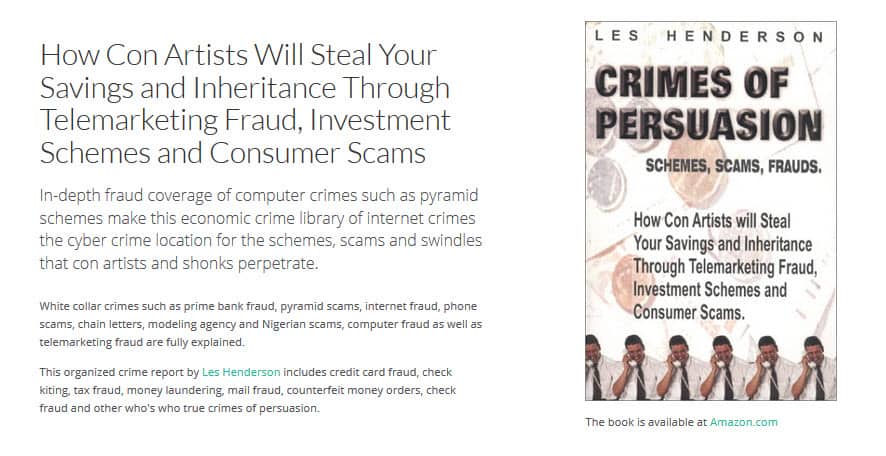
According to Les Henderson, the author of Crimes of Persuasion: Schemes, Scams, and Fraud, new variations of the scheme are being developed all the time, but the most common forms range from the sale of crude oil or other commodities at below-market prices and the transferring of funds from "over-invoiced" or "over-estimated" Nigerian contracts to laying down a deposit to reap a portion of a large unclaimed estate in the future.
He added that some of the phrases one might come across are, "My father left me $40 million in his will but I have to bribe government officials to get it out," or "The Nigerian National Petroleum Company has discovered oil and as government employees we want to acquire the land, but we need a front man to purchase it for us," or "We just sold a bunch of crude oil in Nigeria, but we have to bribe the banker to get it out."
"They essentially need your distant involvement in some illegal, but mostly white-collar criminal proposal," said Henderson. "They will want to get the money out of Nigeria or other West African country by using you as a conduit 'who will benefit greatly from your assistance and cooperation.' "
He added that the crooks want their prey to believe that the venture has an air of secrecy and mystery.
"The goal of the criminal is to delude you into thinking that you are being drawn into a very lucrative, albeit questionable, arrangement," said Henderson. "You must first be reassured and confident of the potential success of the deal without risk to yourself."
Henderson also said beware of scams that express an extreme sense of urgency. "There is always a sense of urgency attached to the proposal," he said "A government audit in the near future will close the window of opportunity or the job of the person able to transfer the funds is in jeopardy."
Why Nigeria?
Many of the scams in the last few years have come out of Nigeria. Henderson explained why.
For one reason, he said, Nigeria is a former British Colony, so most of the population speaks English. But Henderson added that much of it has to do with the country's past.
"I suppose it has to do with the history and customs of the country itself," said Henderson. "Just as Mexico is known for bribery and fixes, any impoverished country has the potential for graft. This means an industry can be established and protected from legal interference."
He added, "They have a lot of educated English-speaking good-natured men who find themselves without employment opportunities but an entrepreneurial desire to succeed."
But he concluded that, to be fair, the Nigerians in no way have the market cornered on such scams.
"America is rife with the same concept, but they just use different advance fee fraud techniques such as fake credit card offers, cramming and boiler room investments," he said. "The Nigerians just found a formula that works and has remained identifiable to the country. American scammers just change the company names more often, obscuring the repetitive, continuous nature of their ongoing and equally destructive operations."
He also said both the American and Nigerian government are ineffective at stopping the scammers, but the Nigerians have so little in terms of resources that it is likely that the scams will never go away.
Wedding Dress Blues
I was trying to sell my wedding dress, and the purchaser, Ladi Williams, from Nigeria sent me a check for $ 4,000 when the dress was offered for only $ 300, asking that I send back the difference to his "shipping agent" BOLA ADEBIYE, 4 BAYO OYEWALE ST, VICTORIA ISLAND, LAGOS, NIGERIA.
After I sent the money from the local outlet, I got a call from Western Union's fraud department. They told me that they don’t send money to Nigeria, and explained the reasons to me.
I was in shock!!! Thank God they gave me my money back as I just got a call from my bank letting me know that the check this person from Nigeria sent did not clear.
I took “some time” letting him believe I would ultimately send it, so he gave me a second address and another shipping agent, Steven Morris, 23 Hoptille Amsterdam, Netherlands
The scammer called me 5 times yesterday, but I did not take any of his calls. He calls me through the AT&T operator, she said that is a call from William. When he calls, he’s emailing, the operator reads it for me, and then she types whatever I tell her. So I have never had heard his voice, and of course, I don’t know if is a man or a woman.
I hope you can help many people that do not know anything about it. Please let me know if there is something else I can do to stop with this sad, and uncomfortable situation.
Letty Reyes 11/05/03
Frederick Man Loses $3,000 in Internet Scam
By Laura Arenschield - The Winchester Star - Virginia (excerpt)
A 22-year-old man is out $2,968 after being taken in an international Internet operation known as the Nigerian Net Scam.
Frederick County Sheriff’s Office Maj. Robert C. Eckman said the scam basically works like this:
“You have something expensive, like a vehicle or a horse, for sale. They contact you saying they're a buyer. If you're selling it for $1,000, they say, 'We'll send you a certified check for $5,000.'"
The “buyer” in the scam says because they live overseas, they will send a “shipper,” who they say lives locally, to pick up the item, Eckman said.
The seller is directed to deposit the certified check and use the money, beyond the cost of the item, to pay the shipper for sending the item overseas.
“You deposit the check in the bank, and the bank clears the check," Eckman said. “The shipper doesn't come by. They ask you to send the remainder back to them."
The Frederick County man was selling a car online, Eckman said. He asked $800 for the 1989 Nissan, Sheriff’s Office Investigator Bob Dean said.
“They sent him a forged cashier's check for $4,000, and he was supposed to send them back $2,800," Dean said. “It cost $168 to send the money Western Union, so he's out a total $2,968."
The man reported the scam to the Frederick County Sheriff’s Office on Oct. 27. Dean said it is unlikely he will ever get his money back.
Man almost victim of scam but teller alertly spots bogus check
by Lynn Commero - Solanco Sun Ledger 2003
11/13/03 - Quarryville, PA police Chief Ken Work believes that if something doesn't sound right, it probably isn't right.
Such was the case for a Peach Bottom man who was almost the victim of a Nigerian Internet scam to steal his money.
According to Chief Work, Phillip Smith, 42, was selling a truck for $5,000 over the Internet when someone responded to his advertisement. E-mails were exchanged back and forth between Smith and the other party with details about how the transaction would be done.
Work said Smith was contacted through e-mail by a "middle man" that he would be sent a cashier's check for $11,000 and that he could take out the money for the truck and send the rest of it in a money order to an address in Nigeria.
"They're hoping the counterfeit check doesn't get cashed," Work said of the Nigerian scam.
When Smith received the $11,000 check made out to him from Traveler's Express Company, Huntington National Bank, Work said he took it to the Wachovia Financial Center, 1 S. Church St., Quarryville, on Oct. 14 to get it cashed, but the bank teller recognized the check as counterfeit and wouldn't cash it.
Work said if Smith would've sent a money order for $6,000 to the address in Nigeria, all he would be left with would be a counterfeit check and the bank would take $11,000 from his account.
By the cashier recognizing the check as counterfeit and not cashing it, she saved Smith from losing $11,000.
Work handled the case because the counterfeit check was passed at a Quarryville bank.
"I did contact the Secret Service since it's a nationwide scam," he said.
No charges have been filed against anyone because it happened over the Internet and it dealt with people from out of the country, said Work.
"Nigeria Connection" scams are usually in the form of a letter or an e-mail from someone in Nigeria, Africa, who tells you they have a famous relative who died and left millions of dollars that need to be taken out of the country.
All they need is for you to help them move the money to the United States.
The reason it is a fake is because before the deal is made, you're asked to provide your bank account number or send money to help cover expenses.
Chief Work said just because Quarryville is a small town doesn't mean that big things, such as Internet scams, don't happen here.
Campus police probe Nigerian e-mail scam
By ANNA BOUDREAU Staff Writer - empiretribune.com 11/21/03
The Tarleton Police Department has recently investigated an e-mail scam which could have cost a Tarleton student more than $5,000. In this case, the perpetrator was unsuccessful, but it did cause the student “some unneeded stress.”
Sgt. Randall Dolloff said this Nigerian scam has been dubbed the 4-1-9 fraud after the fraud section of the Nigerian penal code.
“Frequently e-mail in-boxes are laced with one form of the scam or another," Dolloff said Wednesday. “There is a Nigerian task force dedicated to the Nigerian scams. The U.S. Secret Service has agents posted in Nigeria investigating the cases and rescuing desperate U.S. citizens that have been victims of the scammers."
Dolloff said one of the most successful scams is to target someone selling an item on the Internet such as a car.
“The 'alleged' buyer will contact the person selling the item and make a deal on the price," he said. “The buyer generally states he is in some foreign country but has a contact in the United States.
“The contact is sending a cashier's check to pay for the item, but the catch is the cashier's check is more than the agreed price."
In the Tarleton case, the deal was made to sell the item for $1,000. Dolloff said the buyer led the student to believe his U.S. shipping agent owed him $6,000. The shipping agent was to send a $6,000 check to the seller — the student — and the seller was to wire the remaining $5,000 back to the U.S. shipping agent.
“The address for the shipping agent is actually another wire service," Dolloff said. According to the U.S. Secret Service, a transaction may go through several wire transfers before it gets to its final destination in Nigeria or a foreign bank account.
“It takes a week to 10 days before the forged check returns to the seller's bank," Dolloff said. “In that time the alleged buyer is counting his $5,000 - if he is successful."
Dolloff said Internet and e-mail scams come in many different forms and it is important to be aware of their existence.
“The Nigerian scams have been around a long time before the Internet," he said. “However, the Internet has provided them with a potent vehicle for launching their criminal activity."
Another recent e-mail scam claimed to be from the son of a doctor who has recently deceased and was looking for a U.S. account to deposit his inheritance to get around his country’s rules. A person responding to this scam is invited to come to a foreign country and they are told they will not need a visa.
“If the person responds, they are sent some very official looking documents to perpetuate the person's confidence," Dolloff said. “Once the person arrives in the country - most often Nigeria or a bordering country, they are plundered or sometimes worse.
“Another of the Nigerian scams that has hit my in-box was from Princess Juliet Etete, daughter of King Oti Etete, of the Ogoni Kingdom of Nigeria. Of course the king died and she is looking for someone in the U.S. to allow her to deposit $7,000,000 into their account. Once the scammer gets the target's bank account information - well you can guess the outcome."
For more information on the 4-1-9 fraud, visit the U.S. Secret Service Web site at http://www.secret service.gov/alert419.shtml.
“The scams are varied and changing," Dolloff said. “If something appears to be out of the ordinary, it probably is. Don't fall for it and contact your local law enforcement agency."
Online Fraud Cases Triple
Steve Pardo - Detroit News (excerpt) 12/07/03
Jeff Neumann of Taylor decided to use an Internet auction site to sell his 1989 Camaro IROC Z-28. In the end, he was conned out of $7,500 by someone who pretended to want the car and sent a bogus cashier's check.
Troy resident Mike Bies shipped five National Geographic magazines worth $150 to a would-be buyer on eBay whose personal check turned out to be phony. He went to the eBay site and filed a complaint. EBay shut down the person's account, preventing him from conducting business on the site.
"But it takes about 10 minutes to set up a new account," Bies said.
Consumers also can report such fraud to local police and federal authorities, but they've had little success catching the criminals and getting back stolen items and money. A major problem is deciding which agency should handle a case, especially when the scammer is from another country.
"Even if we're able to identify the perpetrator -- which would be difficult to do -- getting the person over here to stand trial is difficult," said Bill Cousins, a supervisor of fraud squads at the Detroit branch of the U.S. Secret Service. "For a $5,000 fraud case, the U.S. government isn't going to put forth the assets needed."
Auction fraud, at 46 percent of all reported Internet fraud, is by far the most common, said Ronda Ellcessor, communications manager for the National White Collar Crime Center, a federally funded nonprofit corporation that works with police agencies to fight Internet fraud. Victims include people who buy merchandise online and don't receive it or receive inferior items, as well as people like Neumann and Bies, who were defrauded while trying to sell online.
The Internet Fraud Complaint Center, created by the FBI three years ago, received 48,252 fraud complaints last year that were passed on to federal, state and local law enforcement agencies. A year earlier, there were 16,755.
Ellcessor cautions that the $54 million reported scammed from people last year is just a fraction of what consumers actually lost. Thousands of people, too embarrassed by the scams, don't report Internet fraud, she said.
New fraud schemes
Neumann, 35, was contacted via e-mail by someone from Nigeria who offered to buy his Camaro, which was listed on an Internet auction site for sale for $2,100. The potential buyer, who used the name Paul Smith, offered to send a cashier's check to Neumann for $7,500. Neumann was told to keep $2,100 and wire back the change.
Neumann already had sold the car locally by the time he received the $7,500 check. He deposited it into his checking account and waited a week before having his branch, the Detroit Edison Credit Union, wire the $7,500 back to Smith in Nigeria.
Two hours after he wired the money back, he found out the cashier's check was bogus.
"And I was responsible for the $7,500," Neumann said. "I didn't know about this scam. I was under the impression a cashier's check was as good as cash."
William Thiess, president of the Detroit Edison Credit Union, said the credit union does not have a policy to deal with this type of fraud. But he said the credit union was willing to discuss it with Neumann and work out a settlement.
Jessica Roth of Howell experienced a similar scam. She went to freeclassifieds.com to advertise two flutes she had owned since childhood. Within days, someone from Nigeria sent her an e-mail offering to buy the flutes. The person said he would send her a cashier's check for $5,000 and asked that she wire the change to Nigeria.
When the check for $5,000 came, Roth deposited the money in her checking account at TCF Bank in Howell. The teller told her the money would be available the next day.
Her balance showed an extra $5,000 the next day. She withdrew money and wired $4,175 to the Nigerian buyer -- the change due after the purchase price, shipping and Western Union fees.
A week later, TCF Bank had taken $5,000 from her account to cover the bounced check, leaving her $4,700 in the red. "I'm college educated and so is my husband, and I'm suspicious by nature," Roth said. "I feel so stupid I fell for this."
Officials at freeclassifieds.com did not return phone calls seeking comment.
Bank laws aid scammers
The popularity of e-commerce and little understood federal banking rules are helping criminals, said Susan Grant, director of the National Fraud Information Center at the National Consumers League.
"Crooks have discovered a great way to rip people off is through U.S. banks," Grant said. "It's really taken off in the last year. It's ingenious."
Banks are required in most cases to make deposited funds from cashier's checks available by the next day. Depositors see the money in their account days -- or even weeks -- before a cashier's check actually clears and is verified as legitimate. But the person making the deposit is legally liable should the bank discover a deposited check is counterfeit.
Online criminals know the rules, said John Hall, spokesman for the American Bankers Association. "And they're taking advantage of the laws."
Jason Korstange, director of corporate communication for TCF Bank in Minneapolis, said customers are told their responsibilities when they open an account.
"It states in the regulations that whoever is depositing the check is responsible until such time as the money actually clears," Korstange said. "Is the bank going to eat that? No."
Grant said the banks could be doing more to educate customers about banking policies.
Nigerian Auction Scam Victim
11/08 - I have recently been a victim of the Nigerian 419 scam, and just thought you might like to know my experience in the matter.
It started on Facebook when I listed a Rock Band guitar for sale. A man named Joseph John contacted me saying he wanted to purchase it as a birthday gift and that he lived in Nigeria. The destination country seemed a bit sketchy, but I didn't think it was a problem. I paid $95.07 to ship the item.
Two days later, I received an email from a man called Hamman Bello Ahmed, who claimed to be the Comptroller General of the Courier Service Department (spelt in the emails Courire), telling me that my item has been seized and that the man I sent the guitar to has been arrested for fraud and that if he gets convicted, I will be compensated.
Well sure, enough, an hour and a half later after receiving the first email, the man writes back to me saying Joey John has been convicted, has stolen 2.5 million dollars from 5 vicitms, me included, and that I am to be compensated $500 000.
I was told I could either go to Nigeria and pick up my check (!) or hire their courier service and have it delivered to me along with my returned guitar.
So naturally, my first instinct was $500 000????!!! WOW!!!! I wanted to see if this guy was legit, so I Googled his name along with the organisations he claimed to be representing and sure enough, they came up.
So I genuinely thought I was dealing with the real deal. I sent them $200 to cover the shipping fee (they claimed this was necessary to Nigerian NDIC laws stipulating everything must be insured when being sent out of the country), and then they told me my parcel had been shipped.
Well I never received a tracking number and then the next day, I received another email. This time, from Mr. Ahmad and the second, from the Nigerian President (as if, right?).
So, Mr. Ahmad tells me to send another $830 (!!!) USD to cover the fee, because now they've decided to wire the money to me b/c it is such a large amount. So I freaked out, wrote back and simply explained: I'm a student and cannot afford such a large sum.
This went on and on, so I sent $100 hoping this guy would influence the agency responsible for sending the money. Sure enough he came back and told me nothing can be done.
This is when things really became fishy, so I consulted a close friend of mine for advice. She agreed with me that there might be SOME legitimacy here since the man's name came up in a Google search along with the organisations he claimed to represent, yet everything about it seemed off.
And after looking at your website, you point out everything that I noticed was wrong: namely poor spelling and grammar and a large sum of money, along with the usage of names belonging to real officials.
I took my friends advice, and contacted the Nigerian High Commissioner in Ottawa, Canada and the Officer of Chancery told me it's very likely I'm being duped and to stop what I'm doing.
I also got in touch with the RCMP and I was told to basically cut my losses and stop communicating with them. I took their advice and told these 419 folks to (in a kind way) go jump in the lake.
Mr. Ahmad contacted me again, crying about a slap to his face and that I had insulted him. I explained how I pieced everything together and even contacted the Embassy. Sure enough, I get another email from the Nigerian President saying he contacted the CEO of the Embassy in Toronto.
That was enough to make me laugh, as I replied to that email with these exact words: "I might have believed that, if there was an Embassy in Toronto". Sure enough, I didn't receive another email from the El Presidente.
NOW, I have received more emails after I thought the matter was over and done with. They are still persisting. I have deleted the majority of emails sent to me only b/c I wanted to forget about what happened and cut my losses, but it seems as though they won't let up, so I contacted PhoneBusters via email asking for their help. I seriously doubt I will be compensated for the $$ I lost, but hey, at least that can be replaced, right?
-Sammy
Tough break Sammy,
But you aren't the exception or the worst off by a long shot. Many people lose all they have ranging in the tens and hundreds of thousands. Some kill themselves and others are arrested for cashing one of the bogus cheques they are sure to want to send you.
Nigerian Victims Commit Suicide or Get Arrested
Lesson learned this time but there are many other scams awaiting you. Keep reading the site and you might avoid a few.
Les